
Local Innovation and Smart Aquaponics: Strengthening Qatar’s Food Security Future
Local Innovation and Smart Aquaponics: Strengthening Qatar’s Food Security Future
Integrated Farm Featured in Al Watan | 14 April 2026 | Qatar
Qatar’s journey towards a more resilient food-security system increasingly depends on the integration of local agricultural production, engineering innovation and advanced technologies. As environmental challenges and global supply-chain uncertainties reshape the agricultural landscape, developing efficient and locally adapted production systems has become an important national priority.
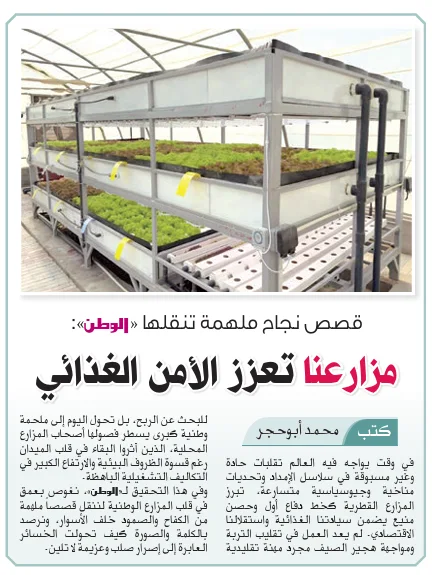
This vision was highlighted in the 14 April 2026 edition of Al Watan newspaper, under the headline “Our Farms Strengthen Food Security” (مزارعنا تعزز الأمن الغذائي). The newspaper featured an aquaponics system developed by Integrated Farm for Consulting on its front page, with related coverage on page 7, bringing attention to the contribution of local agricultural innovation to Qatar’s food-security ambitions.
Engineering Agriculture for Qatar
At the centre of Integrated Farm’s technology development is CHAS — Commercial Hybrid Advanced Sustainable Aquaponics System, a commercially oriented hybrid aquaponics platform developed with Qatar’s environmental and operational conditions in mind.
CHAS integrates fish production, biological water treatment and multiple plant-cultivation technologies within one coordinated production environment.
Depending on the system configuration, its architecture can incorporate:
Recirculating Aquaculture Systems (RAS) for fish production.
Deep Water Culture (DWC) for leafy vegetable cultivation.
Nutrient Film Technique (NFT) growing channels.
Media-based cultivation systems.
Biological filtration and water-treatment components.
Sensors, monitoring and automation-ready infrastructure.
By combining these technologies, the system aims to optimise the use of available resources while supporting integrated fish and crop production.
For Qatar, where water efficiency, climate adaptation and operational reliability are essential considerations, locally engineered agricultural systems offer an opportunity to develop production models suited to the country's specific needs.
Beyond Technology: A Complete Agricultural Engineering Approach
Developing a successful agricultural system requires more than introducing new equipment or growing technologies. It requires an understanding of biological processes, water management, engineering, operational requirements and commercial production.
Integrated Farm works across the agricultural technology lifecycle, including consultancy, system design, local fabrication, commissioning, facility management, research and development, sensors and automation.
This integrated approach focuses on developing systems that can move beyond demonstration projects and become practical, maintainable and commercially viable agricultural facilities.
The Next Generation: Data, Automation and Artificial Intelligence
The future of agricultural production will increasingly depend on reliable data and intelligent operational management.
In aquaponics, maintaining suitable water conditions is essential for both fish health and plant development. Key monitoring parameters include pH, dissolved oxygen, water temperature, water flow and water level, supported by periodic testing of ammonia, nitrite, nitrate and alkalinity.
Integrating these measurements with sensors, automation and data-analysis platforms can help operators identify abnormal conditions, improve operational consistency and make better-informed decisions.
Artificial intelligence and robotics can further contribute to this development when built on reliable operational data and validated agricultural models. The objective is not technology for its own sake, but practical innovation that improves system performance, resource efficiency and production reliability.
Building Qatar’s Agricultural Technology Ecosystem
Strengthening food security requires collaboration across the agricultural and technology sectors.
Local agricultural companies, universities, research institutions, engineers, investors and commercial food producers all have complementary roles to play.
Research partnerships can support scientific validation, automation, robotics and advanced system development. Local engineering companies can translate research into practical technologies, while commercial farms provide the operational experience and production data required for continuous improvement.
This cooperation can help establish a stronger agricultural technology ecosystem in Qatar, creating opportunities for local expertise, applied research and commercially relevant innovation.
From Local Innovation to National Impact
The appearance of Integrated Farm’s CHAS system in Al Watan represents an encouraging recognition of the role that locally developed agricultural engineering can play in Qatar’s food-security landscape.
However, the long-term objective extends beyond media recognition. It is to transform technological innovation into dependable production capacity, efficient resource management and commercially sustainable agricultural operations.
Qatar’s food-security future will require a combination of resilient supply chains, strategic planning, efficient farms, protected agriculture, research and advanced production technologies. Smart aquaponics can contribute to this future as one component of a broader, integrated agricultural strategy.
For Integrated Farm, the mission is to continue engineering practical agricultural solutions adapted to local conditions and contribute to the development of a more innovative, resource-efficient and resilient food-production ecosystem in Qatar.
Integrated Farm — Engineering Nature. Empowering Food Security.
Original Newspaper Reference
Al Watan — 14 April 2026
Front-page feature: “Our Farms Strengthen Food Security” (مزارعنا تعزز الأمن الغذائي)
Related coverage: Page 7.
Read the original Al Watan newspaper edition (PDF)